
How a heart bypass works
Coronary Artery Disease and Heart Bypass Surgery (CABG)
Coronary Artery Disease (CAD) is one of the most common heart conditions worldwide. When the arteries that supply blood to the heart muscle become narrowed or blocked, the heart struggles to get the oxygen it needs. For many patients, Heart Bypass Surgery—technically known as Coronary Artery Bypass Grafting (CABG)—is the most effective way to restore blood flow and prevent a heart attack.
In brief
• CAD occurs when plaque builds up in the arteries, restricting blood flow to the heart.
• CABG surgery creates a “detour” around blocked arteries using a healthy blood vessel from another part of the body.
• Delhi’s cardiac centers utilize advanced techniques, including “off-pump” or beating-heart surgery.
• International patients typically spend [PLACEHOLDER: typical duration of hospital stay] in the hospital followed by a period of local recovery.
• SOS Remedy assists with hospital selection, visa invitation letters, and post-operative care coordination.
Understanding Coronary Artery Disease (CAD)
Your heart is a muscle that works 24/7. To do this, it requires a steady supply of oxygen-rich blood, delivered through the coronary arteries. Over time, substances like cholesterol, fats, and calcium can build up on the inner walls of these arteries. This buildup is called plaque.
As plaque grows, it causes a condition called atherosclerosis. The arteries become narrow and stiff, making it difficult for blood to reach the heart muscle. This can lead to:
• Angina: Chest pain or discomfort during physical activity.
• Shortness of breath: Feeling winded even with minor exertion.
• Heart Attack: If a plaque ruptures or a clot forms, blood flow can be cut off entirely, damaging the heart muscle.
When lifestyle changes, medications, or less invasive procedures like angioplasty (stents) are not enough, CABG is recommended to bypass the blockages.
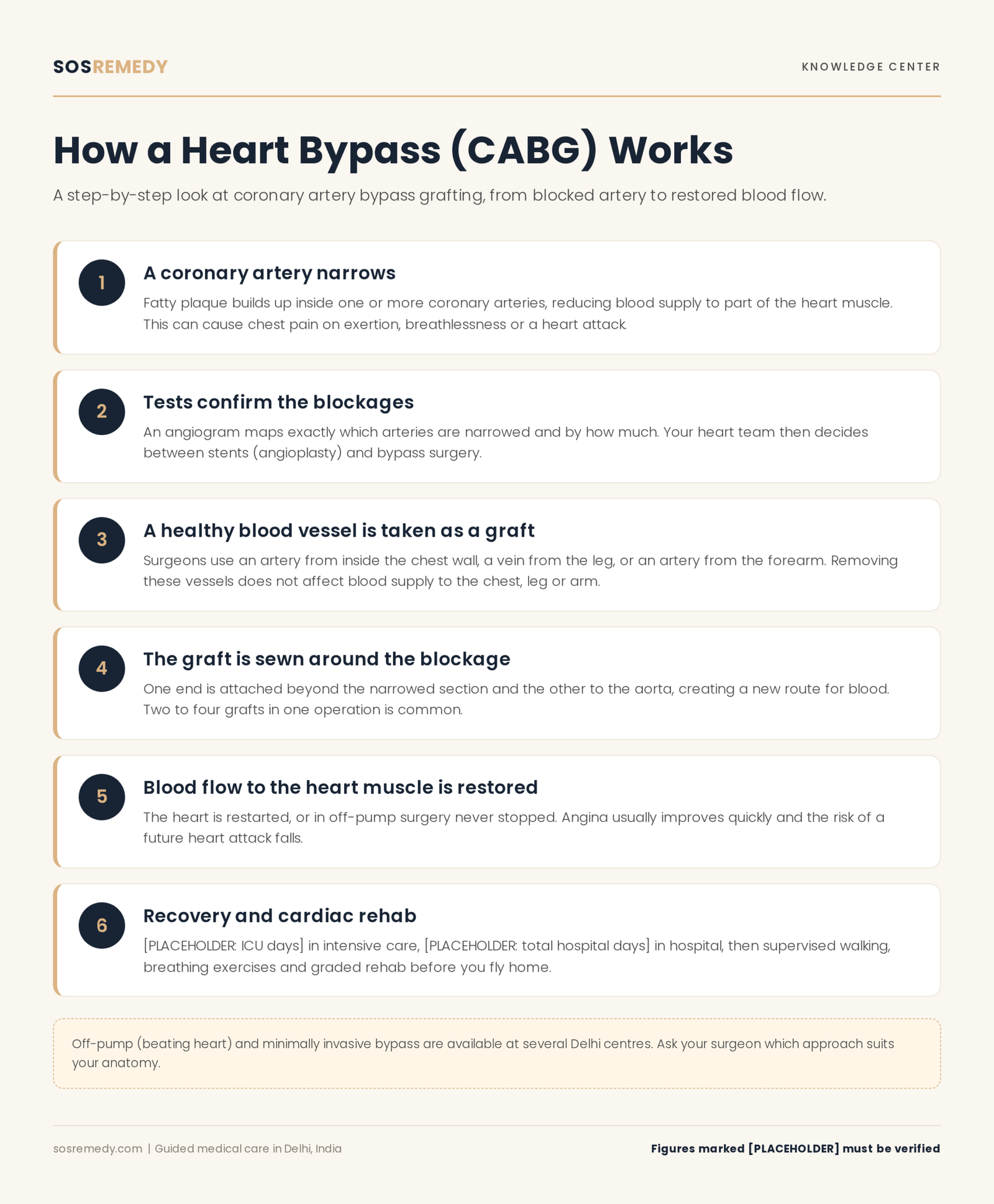
How the CABG procedure is performed
The goal of CABG is to create a new route for blood to reach the heart. Think of it like building a new road to go around a traffic jam.
Who needs Heart Bypass Surgery?
Not everyone with heart disease requires surgery. However, a cardiac surgeon may recommend CABG if:
• You have severe blockages in the left main coronary artery, which supplies most of the blood to the left ventricle.
• Multiple coronary arteries are narrowed, limiting the heart’s overall function.
• You have diabetes along with multi-vessel disease.
• A previous stent has failed or the artery has narrowed again.
• You are experiencing severe chest pain that hasn’t improved with medication.
What to expect: Your journey in Delhi
For international patients, the process is streamlined to ensure safety and comfort
Before Surgery
You will undergo a "pre-anesthesia check-up" (PAC). This includes blood tests, chest X-rays, ECGs, and sometimes a fresh coronary angiogram to map the blockages precisely. You will meet your surgical team to discuss the risks and the specific technique they will use.
The Day of Surgery
The procedure usually takes [PLACEHOLDER: duration of surgery in hours]. You will be under general anesthesia and will not feel any pain.
Immediate Post-Op
You will wake up in the Cardiac ICU (CTVS-ICU). You will have several tubes and monitors attached to you, including a breathing tube (ventilator) for the first few hours. The nursing staff will monitor your vitals every few minutes
Recovery Timeline
| Phase | Duration | What happens |
|---|---|---|
|
ICU Stay |
[PLACEHOLDER: days in ICU] |
Close monitoring, removal of
breathing tube, and initial
mobilization (sitting up) |
|
Hospital Room |
[PLACEHOLDER: days in ward] |
Walking in the corridors, pain
management, and breathing
exercises (spirometry) |
|
Local Stay (Delhi) |
[PLACEHOLDER: days in guest house] |
Frequent follow-ups, wound checks,
and ensuring you are fit to fly.
|
|
Full Recovery |
[PLACEHOLDER: months for full
recovery] |
Returning to work and normal
physical activity; sternum
(breastbone) fully heals. |
Honest assessment of risks
CABG is a major surgery. While the success rate in top Delhi hospitals is [PLACEHOLDER: percentage success rate], it is important to understand the risks:
Bleeding or Infection
As with any surgery, there is a risk of infection at the chest or graft site.
Heart Rhythm Issues
Arrhythmias (like atrial fibrillation) are common during recovery but usually manageable.
Kidney or Lung Issues
Temporary changes in function can occur, especially in older patients.
Stroke
There is a small risk [PLACEHOLDER: percentage risk of stroke] associated with the use of the heart-lung machine or manipulation of the aorta.
Harvesting the Graft
The surgeon first takes a healthy blood vessel (a "graft") from another part of your body. Common sites include the internal mammary artery (inside the chest), the radial artery (in the arm), or the saphenous vein (in the leg).
The Bypass
The surgeon attaches one end of the graft above the blockage and the other end below the blockage. This allows blood to "bypass" the narrow section.
Surgical Techniques
There are two primary ways this is done in Delhi's leading hospitals: • On-Pump CABG: A heart-lung bypass machine takes over the work of your heart and lungs so the surgeon can operate on a still heart. • Off-Pump (Beating Heart) CABG: The surgeon uses specialized equipment to stabilize the part of the heart being worked on while the rest of the heart continues to beat. This technique is often preferred for patients at higher risk of complications from the bypass machine.
Your surgeon will discuss these risks relative to your specific health profile before you sign the consent form.
Questions to ask your surgeon
When you have your initial video consultation through SOS Remedy, consider asking:
- Which technique do you recommend for me: On-pump or Off-pump?
- How many CABG procedures do you perform annually?
- Where will the grafts be taken from (arm, leg, or chest)?
- What is the expected lifespan of the grafts you are using?
- What are the specific risks based on my pre-existing conditions (e.g., diabetes)?
Frequently asked questions
Internal mammary artery grafts (from the chest) have a very high long-term success rate,
often remaining open for [PLACEHOLDER: number of years]. Vein grafts from the leg may
have a slightly shorter lifespan, but modern medications help extend their utility.
No. We recommend staying in Delhi for at least [PLACEHOLDER: recommended days
post-discharge] before taking a long-haul flight to ensure there are no immediate
complications and that your lungs are clear.
For some patients with single or double vessel disease, surgeons can perform the bypass
through a small incision between the ribs rather than opening the breastbone. Your surgeon
will determine if you are a candidate.
You will feel soreness in your chest and at the graft sites. However, modern pain
management protocols ensure that you are comfortable enough to walk and perform
breathing exercises within 24–48 hours.
Yes, most patients will need to stay on blood thinners (like aspirin) and cholesterol-lowering
medications (statins) indefinitely to keep the new grafts clear and prevent further CAD.
6. What is the success rate for CABG in Delhi?
Yes, most patients will need to stay on blood thinners (like aspirin) and cholesterol-lowering
medications (statins) indefinitely to keep the new grafts clear and prevent further CAD.
6. What is the success rate for CABG in Delhi?
Still have a question?
Talk to a care coordinator directly, no bot, no queue.